
Call: 07971189199
 Send Inquiry
 Send Inquiry
Laboratory Digital Colorimeter
MOQ : 1 Piece
Laboratory Digital Colorimeter Specification
- Accuracy
- 0.02 O.D.
- Power Supply
- AC 230V / DC 12V Adapter
- Glass Type
- Optical glass cuvettes
- Features
- Compact design, easy calibration, accurate readings
- Control Type
- Membrane keypad
- Shape
- Rectangular
- Temperature Resistance
- Ambient conditions
- Display Type
- Bright 3-Digit LED display
- Type
- Digital Laboratory Colorimeter
- Dimension (L*W*H)
- 270 x 225 x 120 mm
- Equipment Type
- Bench-top Colorimeter
- Equipment Materials
- Metal body with powder coated finish
- Power
- 12V DC, 1.5 Amps Adapter
- Voltage
- 230V AC 10%, 50 Hz
- Material
- Metal and High-grade components
- Application
- Measurement of color intensity, chemical analysis in lab
- Capacity (Ltr)
- Sample-based, not specified in litres
- Weight
- Approx. 3 kg
- Light Source
- 6V Tungsten Lamp
- Calibration
- Manual and zero adjustment
- Resolution
- 0.01 O.D.
- Wavelength Range
- 400-700 nm
- No. of Filters
- 8 (Glass
- Measuring Range
- 0-2.00 O.D. (Optical Density)
- Readout Mode
- Direct digital
- Sample Volume
- 1 ml min.
- Standard Accessories
- Set of cuvettes, power adapter, instruction manual
- Colour Standards
- Suitable for colorimetric estimation of chemicals
- Operating Temperature
- 10°C to 40°C
- Fuse Protection
- Yes, built-in
Laboratory Digital Colorimeter Trade Information
- Minimum Order Quantity
- 1 Piece
- Supply Ability
- 15 Pieces Per Day
- Delivery Time
- 15 Days
- Main Domestic Market
- All India
About Laboratory Digital Colorimeter
Other details
|
MODELS |
WAVELENGTHS |
PRECISION & MODES |
|
HANS 251 |
Five Wavelengths 450, 505, 530, 580, 630 |
Up to 2 Decimal Precision (0.00), Absorbance Mode Only |
|
HANS 253 |
Five Wavelengths 450, 505, 530, 580, 630 |
Up to 2 Decimal Precision (0.00), Absorbance Mode Only |
|
HANS 291/391 |
Nine Wavelengths 405, 430, 465, 505, 530, 565, 580, 630, 700 |
Up to 2 or 3 Decimal Precision (0.00)/ (0.000) ,Absorbance Mode Only |
|
HANS 293/393 |
Nine Wavelengths 405, 430, 465, 505, 530, 565, 580, 630, 700 |
Up to 2 or 3 Decimal Precision (0.00)/ (0.000) Absorbance, Concentration & Factor Modes |
Specification
|
LIGHT SOURCE |
LED Life Long Light Source |
|
METHODS |
ABSORBANCE, END POINT |
|
REAGENT VOLUME |
0.250ml in Semi Micro Cuvette |
|
0.500ml in Micro Square Cuvette |
|
|
1ml in Round Glass Cuvette |
|
|
CALIBRATION |
AUTO CALIBRATION with Known Standard or Artificial Standard |
|
PHOTOMETRIC RANGE |
0.000 -3.500ABS |
|
DISPLAY |
LCD with Blue White Backlight, Alphanumeric |
|
KEYBOARD |
16 Keys,0-9Nos, with Haemoglobin(Hb), Calibration (CAL), Absorbace(ABS), ENT KEY |
|
POWER |
5A, 3 Pic, 230V and BATTERY Box with 8 A batterys |
Versatile Measurement Capabilities
Equipped to measure within a 400-700 nm wavelength range and featuring eight durable optical glass filters, this colorimeter allows users to analyze a wide array of chemicals and substances. Its sensitivity and precision make it essential for colorimetric and chemical analysis applications across research, clinical, and industrial lab environments.
User-Friendly Digital Operation
A membrane keypad alongside a bright 3-digit LED display delivers straightforward interaction and direct readout of optical density values. This digital laboratory colorimeter supports both manual calibration and zero adjustment, ensuring consistently accurate results and facilitating smooth operation for both novice and experienced users.
Robust and Portable Design
The colorimeters compact, rectangular form (270 x 225 x 120 mm) and lightweight build (approximately 3 kg) make it suitable for bench-top use without consuming excessive space. Its powder-coated metal construction not only provides durability but also offers resistance to ambient temperatures and the rigors of daily laboratory handling.
FAQs of Laboratory Digital Colorimeter:
Q: How do I calibrate the Laboratory Digital Colorimeter before use?
A: Manual calibration and zero adjustment are performed using the membrane keypad, following instructions in the included manual. Calibration helps ensure the accuracy of all measurements.Q: What types of samples can be measured with this colorimeter?
A: The unit is designed for colorimetric estimation of chemicals and is compatible with sample volumes as low as 1 ml, using supplied optical glass cuvettes. It is suitable for use in research, educational, clinical, and industrial laboratory settings.Q: When should I use the different glass filters provided?
A: Each of the eight glass filters corresponds to different wavelengths (400-700 nm) for analyzing various substances. Select the filter that matches your analytes absorbance peak for best results.Q: Where is this colorimeter most effectively utilized?
A: It is ideal for laboratory benches in research institutions, schools, clinics, and industrial facilities where reliable color and chemical concentration measurements are needed.Q: What is the process for taking a measurement using this device?
A: Place your prepared sample in one of the supplied cuvettes, insert it into the instrument, set the required filter, calibrate to zero, and press the membrane keypad to receive a direct digital readout of optical density.Q: How does the colorimeter ensure measurement accuracy and safety?
A: Accuracy is ensured by high-resolution detection (0.01 O.D.) and precise calibration. Fuse protection and robust electrical design safeguard both the instrument and the user during operation.Q: What are the main benefits of using this digital laboratory colorimeter?
A: It offers rapid, accurate, and straightforward measurement of sample color intensity, with easy operation, reliable calibration, and a compact, durable design for busy laboratory environments.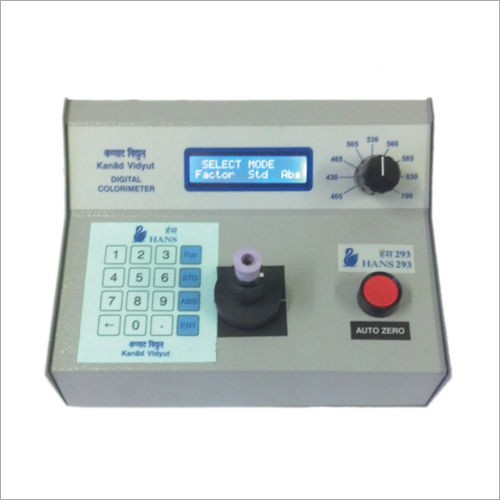
Tell us about your requirement

Price:
Quantity
Select Unit
- 50
- 100
- 200
- 250
- 500
- 1000+
Additional detail
Mobile number
Email


Contact Details
GST : 27AAPPR5912D1ZI
- B No.6/10, Erandwane, Deenanath Mangeshkar Hospital Road, Pune - 411004, Maharashtra, India
- Phone :07971189199
 Send Inquiry
Developed and Managed by Infocom Network Private Limited.
